







For most UAE drivers, both nitrogen and regular compressed air are suitable options for inflating tyres. Nitrogen offers slower natural pressure loss and lower moisture content, while regular air has clear advantages in availability, convenience, and cost. Neither option eliminates the need for regular pressure checks or routine tyre maintenance.
This distinction matters more in the UAE because tires are used frequently in high ambient temperatures, on continuous highways, and under heavy loads. Nitrogen isn't always the superior choice, even in Dubai's heat. The real question is whether its benefits are worth the extra work or cost, depending on how you use your car.
What Is the Difference Between Nitrogen and Regular Air?
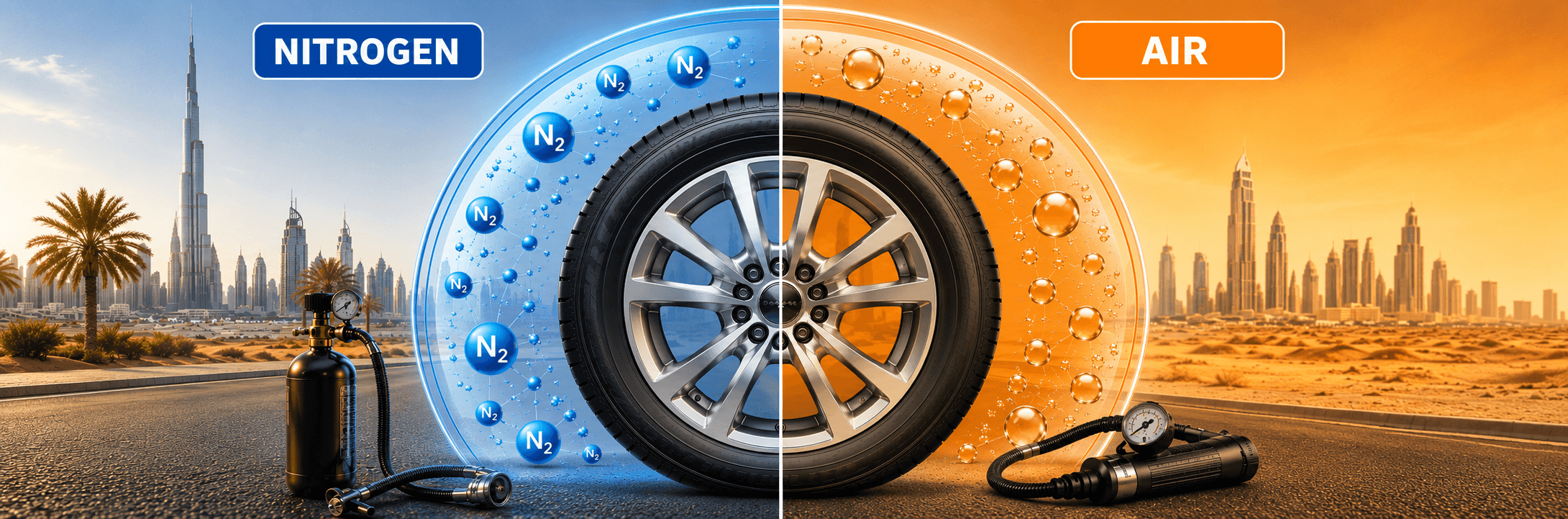
Regular compressed air and nitrogen inflation are not completely different gases. Ordinary atmospheric air contains about 78% nitrogen, with the rest being oxygen and small amounts of other gases and water vapor.
Nitrogen inflation increases the nitrogen concentration and reduces oxygen and moisture inside the tyre.
- Regular Compressed Air
The most common recommended use is passenger cars with compressor air. Installation via equipment sold at petrol stations, workshops, and even virtually any tyre shop UAE.
Financial gain is its greatest strength. When pressure drops along a route between Dubai and Abu Dhabi, it is usually easy to find a point where it can be adjusted.
- Nitrogen Inflation
Nitrogen is supplied mostly as a dry gas. Its practical merit is that car tyres stuffed with a high content of nitrogen are likely to lose pressure not so speedily as compared to those stuffed with normal compressed air. Michelin confirms that use of nitrogen instead of oxygen minimises the pressure that is lost naturally (since the tyres using nitrogen must still be checked at regular intervals).
Nitrogen vs. Air: Which Performs Better?
The comparison becomes clearer when you consider each factor separately.
| Factor | Nitrogen | Regular Air | Better Choice |
|---|---|---|---|
| Pressure retention | Slower natural pressure loss | Loses pressure somewhat faster | Nitrogen |
| Moisture content | Very low when properly supplied | Can contain moisture | Nitrogen |
| Availability | Requires dedicated equipment | Available almost everywhere | Air |
| Cost | May carry an additional charge | Usually free or inexpensive | Air |
| Emergency top-up | Less convenient | Very easy | Air |
| UAE daily driving | Suitable | Suitable | Either |
| Pressure checks | Still required | Required | Same |
| Alignment/balancing benefit | None | None | Same |
How Do They Compare in UAE Summer Heat?
This is where nitrogen marketing can become misleading. Nitrogen does not make a tyre immune to temperature-related pressure changes.
- Pressure Changes With Temperature
Air, like nitrogen, is temperature sensitive. The pressure in the tyre rises when driving and falls when cooling.
Primarily, since nitrogen is a dry gas that is brought to the company properly, the amount of moisture in compressed air may vary. Dry nitrogen eliminates moisture as a source of pressure variation. But both gases are still sensitive to temperature.
- Underinflation Matters More
For UAE drivers, it's better to start with the appropriate cold pressure rather than nitrogen.
When walking, an underinflated tyre is overly flexed. These raise the amount of heat production, rolling resistance, and tyre wear. Michelin, in particular, cautions that underinflation increases fuel use, speeds up wear and tear, alters handling, and creates more heat.
A tyre that is filled with nitrogen and runs below the pressure necessary would thus not have special protection against such problems.
Which Holds Tyre Pressure Longer?
Here, nitrogen has the clearer advantage.
- Nitrogen: Better Pressure Retention
Oxygen escapes more slowly than nitrogen through the materials of tyres. This means nitrogen tyres can keep their desired pressure longer. Both Michelin and Bridgestone list slower pressure loss as a benefit of nitrogen inflation. This could apply to high-mileage drivers who travel long distances weekly.
- Air: Requires More Attention
Ordinary air naturally escapes gradually from tyres. Tyres naturally lose about 0.1 bar, or 1.45 PSI, per month (Michelin); the loss may also be caused by valves, punctures, rims, and other factors. This does not render air unsuitable. It just makes periodic pressure monitoring important.
Does Nitrogen Improve Fuel Economy or Tyre Life?
The answer is indirect rather than yes or no.
- Fuel Economy
Nitrogen itself does not cause the engine to burn less fuel. The potential benefit is being able to maintain proper pressure longer.
Underinflation increases rolling resistance. So, if nitrogen prevents the slow loss of pressure between checks, it might indirectly improve fuel economy.
However, a tire containing air at the proper pressure does not necessarily have a disadvantage in terms of fuel economy because of the presence of air.
- Tyre Life
The same is applicable to tread life. Adequate inflation is good to make tyres wear uniformly. But nitrogen is not able to compensate for the wear due to lack of proper wheel alignment and balance on the wrong wheel, suspension parts, aggressive driving, or unsuitable tyre specification.
What Happens If You Mix Air and Nitrogen?
Nothing dangerous.
You can safely mix nitrogen and compressed air. Michelin specifically states that you can mix the two when additional pressure is required.
- If Your Nitrogen Tyre Is Low
Imagine that during a long trip in the UAE, your tyre-pressure alarm is activated, and all that you have is compressed air. Add air and regain the proper pressure.
The worst thing you can do is drive on an underinflated tyre because you need to maintain the nitrogen level.
- What Changes After Mixing?
The amount of nitrogen simply decreases. To some extent, you lose the pressure-retention benefit, yet the tire can still be used when inflated properly.
Can Nitrogen Replace Regular Tyre Maintenance?
No. This is where the limits of nitrogen matter.
- Wheel Alignment : Incorrect wheel alignment can cause feathering, shoulder wear, steering pull, and rapid tread deterioration. Nitrogen cannot change wheel geometry.
- Wheel Balancing : Poor wheel balancing can produce vibration, particularly as road speed increases. Changing the inflation gas will not correct an imbalanced wheel-and-tyre assembly.
- Pressure and Tread Checks : Nitrogen-filled tyres can still lose pressure due to punctures, valve leaks, damaged rims, or sealing problems. Michelin therefore recommends regular pressure monitoring even when nitrogen is used.
So, Which One Should UAE Drivers Actually Choose?
There is no universal winner. The better option depends on how the vehicle is used.
- Choose Nitrogen If : You want a slower, natural loss of pressure, prefer a dry inflation gas, make long weekly trips, and want the convenience of filling with nitrogen.
- Choose Regular Air If :You want as much convenience as possible, do not wish to have to pay more because of inflation, and have to check tyre pressures on a regular basis anyway. When commuting at normal speeds and driving a family car, compressed air is the way to go.
- For Performance, SUV and Luxury Cars : Do not believe that nitrogen is necessarily needed since the vehicle or tyre brands are premium. It is rather important to have the right tyre specification, its load rating, its speed rating, inflation pressure, and maintenance.
Conclusion
Nitrogen performs better on pressure retention and low moisture, whereas regular air performs better on availability, convenience, and cost. For most UAE drivers, that is the real comparison. In the same setup, when both sets of tires are kept at the correct pressure, neither offers a significant advantage in grip, alignment, balancing, or tread life.
TyresCart allows drivers seeking online car tyres UAE to compare brands, tire sizes, and vehicle fitments. No matter what you fill your tyres with, nitrogen or air, regular tyre inspection, optimal inflation, professional wheel adjustment, and tyre balancing will go a long way in determining long-term tyre performance.