







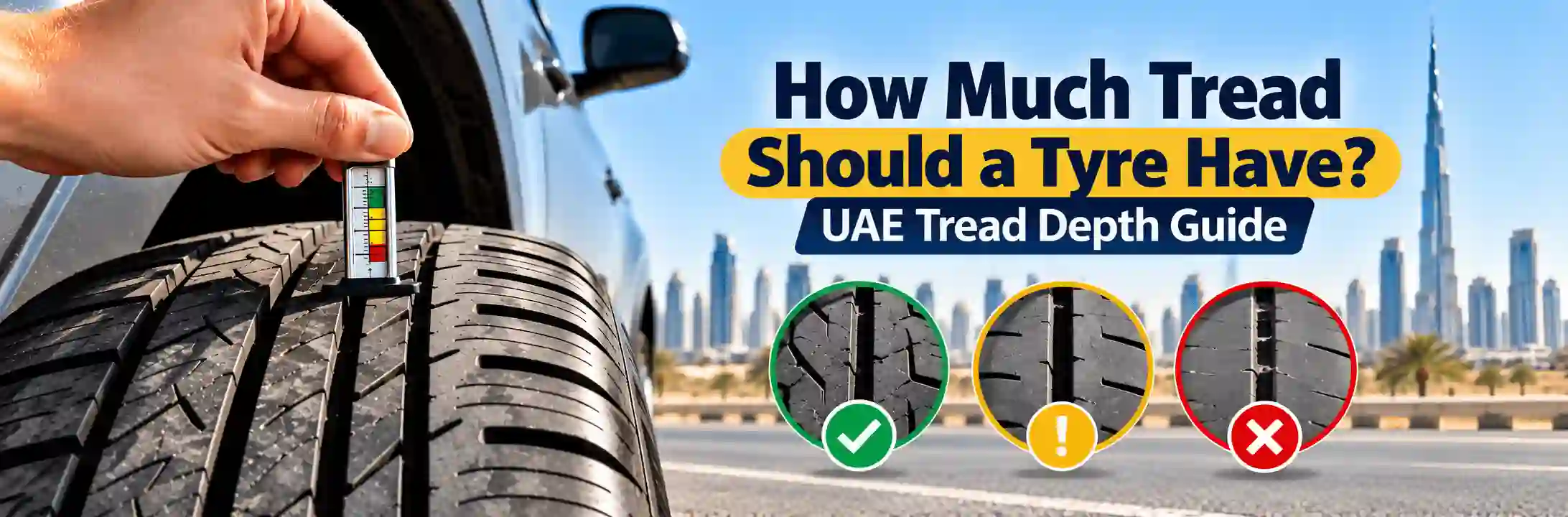
Replace passenger car tyres once tread depth reaches the applicable minimum wear limit; Michelin Middle East uses 1.6 mm as the replacement threshold for car tyres.
Tyres should also be replaced earlier if they have structural damage, cracks, bulges or other conditions that make them unsafe, even when measurable tread remains.
Tread depth is the vertical distance from the top of the tread rubber to the bottom of the main tread grooves. These grooves help move water away from the contact area so the tyre can maintain better road contact in wet conditions. Michelin notes that tread depth plays an important role in water drainage and delaying aquaplaning.
Knowing how to check tyre tread depth and UAE requirements can help you spot worn tyres before they become a road-safety issue.
When Should You Replace a Tyre Based on Tread Depth?
Michelin Middle East identifies 1.6 mm as the minimum tread-depth threshold for car tyres and recommends replacement once the tread reaches that level. Its tread wear indicators are also designed around the same 1.6 mm threshold.
Treat 1.6 mm as a replacement threshold, not as a maintenance target. Regular checks should identify uneven wear, damage or pressure-related problems before the tyre reaches that point.
A tyre may also need replacing before it reaches 1.6 mm if it has cracks, cuts, bulges, tread damage, or any other flaw that makes it unsafe. This is especially important for tyres in the UAE used for frequent motorway driving, where tyre condition, pressure, and structural integrity all matter.
Why Does Tyre Tread Depth Matter?
Tread affects several key aspects of tyre performance, especially traction and water evacuation.
- Wet-Road Performance
Tread grooves help move water away from the tyre’s contact patch. As the grooves become shallower, the tyre has less capacity to evacuate water, which can reduce wet-road performance.
This is important even in the UAE. Although rainfall can be fairly rare, once the roads are wet, adequate tread is important to sustain contact with the road.
- Braking and Handling
Tyre condition affects braking, grip and steering response. Michelin states that tyres should be replaced once the tread reaches the wear indicators at 1.6 mm. Tread condition must be considered alongside the correct pressure, tyre construction, and the vehicle manufacturer's specifications.
How Can You Measure Tyre Tread Depth?
A tread-depth gauge is one of the simplest and most accurate ways to measure the remaining depth of the main tread grooves. This small instrument measures the remaining depth of the tyre grooves in millimetres.
Do not take only one measurement. Test various points on the tread and around the tyre. One part may wear faster than another, especially if there is an alignment, inflation, or suspension issue.
Michelin recommends checking tread depth with a gauge and also using the tyre’s built-in tread wear indicators as a visual reference. It advises checking at multiple points across the tread and around the tyre because wear may not be uniform.
In case you are not sure how to measure the tyre correctly, have it professionally checked.
What Are Tyre Tread Wear Indicators?
Tread wear indicators, often called wear bars, are small raised ribs moulded into the main tread grooves. They provide a visual reference for the minimum tread threshold. On Michelin tyres, the wear indicators are 1.6 mm high, so when the surrounding tread becomes level with them, the tyre has reached the replacement threshold.
Check multiple indicators around each tyre instead of just one. If one side reaches the indicators much earlier than the other, the issue may be more than normal tyre wear.
Why Do Some Tyres Wear Unevenly?
A normal tyre shouldn't develop extreme variations in tread depth across its surface. Uneven wear may indicate another car or a mechanical issue.
- Incorrect Tyre Pressure
Underinflation and overinflation can change how the tread contacts the road and contribute to abnormal or premature wear. Use the cold tyre pressure recommended by the vehicle manufacturer. Do not use the maximum pressure printed on the tyre sidewall as the normal inflation target.
- Wheel Alignment Problems
Incorrect wheel alignment or camber can cause one side of the tread to wear faster than the other. Michelin recommends professional geometry diagnosis when uneven wear suggests an alignment or suspension problem.
Replacing the tyre without proper alignment adjustment may cause the new tyre to develop the same wear pattern.
- Suspension Problems
Worn or damaged suspension components can also affect how the tyre contacts the road. Unusual tread patterns should therefore be investigated as a possible mechanical issue rather than treated only as a tyre problem.
Should You Replace a Tyre Before It Reaches 1.6 mm?
Yes, in some cases. Tread depth is only one part of tyre condition, so you may need to replace a tyre before it reaches 1.6 mm if it has structural damage or severe irregular wear. Damage, age, and uneven wear may necessitate replacement sooner.
Replace or professionally inspect a tyre if you find:
- Cracks or cuts in the sidewall
- Bulges or deformation
- Exposed internal material
- Severe or irregular tread wear
- Repeated pressure loss
- Physical damage after hitting a kerb or pothole
Michelin specifically lists cracks, cuts, bulges, exposed bead wire, separated tread and deformation as reasons for concern.
Does UAE Weather Affect Tyre Tread Wear?
UAE heat and driving conditions can influence tyre wear, but temperature alone does not determine tyre life. Driving style, vehicle weight, tyre compound, inflation pressure, wheel alignment, mileage, and road conditions all affect tyre life.
Incorrect inflation is especially significant in hot conditions, as it can lead to abnormal wear and extra heat. Check tyre pressure regularly and measure it when the tyres are cold, using the vehicle manufacturer’s recommended pressure.
Instead of using mileage to estimate the tyre life, visually inspect and measure the tread.
Does the Best Tyre Brand in the UAE Last Longer?
Not necessarily. There is no single best tyre brand in the UAE for every vehicle and driver, and brand name alone does not determine tread life.
Different tyre models from the same manufacturer may use different compounds and tread patterns depending on whether they focus on comfort, performance, efficiency, off-road traction, or lifespan.
Select tyres according to the vehicle’s required tyre size, load index, speed rating and intended use, then maintain the correct pressure and wheel alignment to support even wear and maximise tyre service life.
How Often Should You Check Your Tyre Tread?
Regular vehicle maintenance should include a brief visual check of tyres, and you should check tread depth periodically and whenever you notice abnormal wear.
Check sooner if the vehicle begins pulling to one side, you notice abnormal tyre noise, steering behaviour changes, or one section of a tyre appears more worn than the rest.
Remember to check the inner tread as well as the outer tread. Severe inner-edge wear can be difficult to see during a quick visual inspection from outside the vehicle.
Conclusion
When your tyres are approaching the tread-wear threshold, check more than tread depth alone. Inspect for uneven wear, cuts, cracks, bulges and pressure loss, then choose a replacement that matches the vehicle’s required size, load index and speed rating.
TyresCart allows UAE drivers to search for tyres by size or vehicle and book fitting through its UAE installer network. Its current store locator shows fitting options across Dubai, Abu Dhabi, Sharjah, Ajman, Ras Al Khaimah, Fujairah and Umm Al Quwain, with workshop and mobile fitting options available depending on location.
If your tread is close to the replacement threshold or wearing unevenly, have the tyres inspected before ordering. That helps confirm whether you need replacement alone or also need alignment, pressure correction or another mechanical issue addressed.