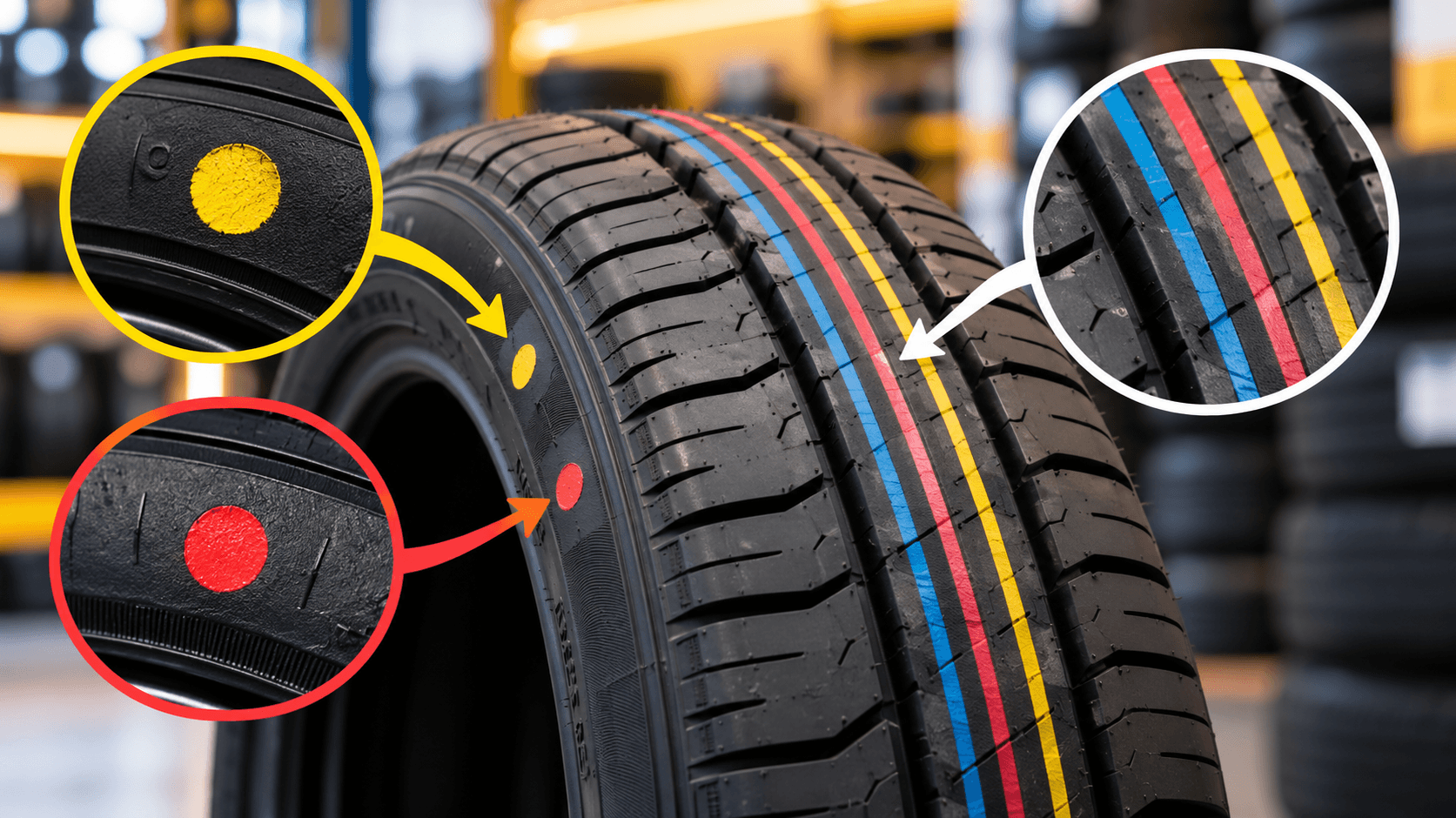








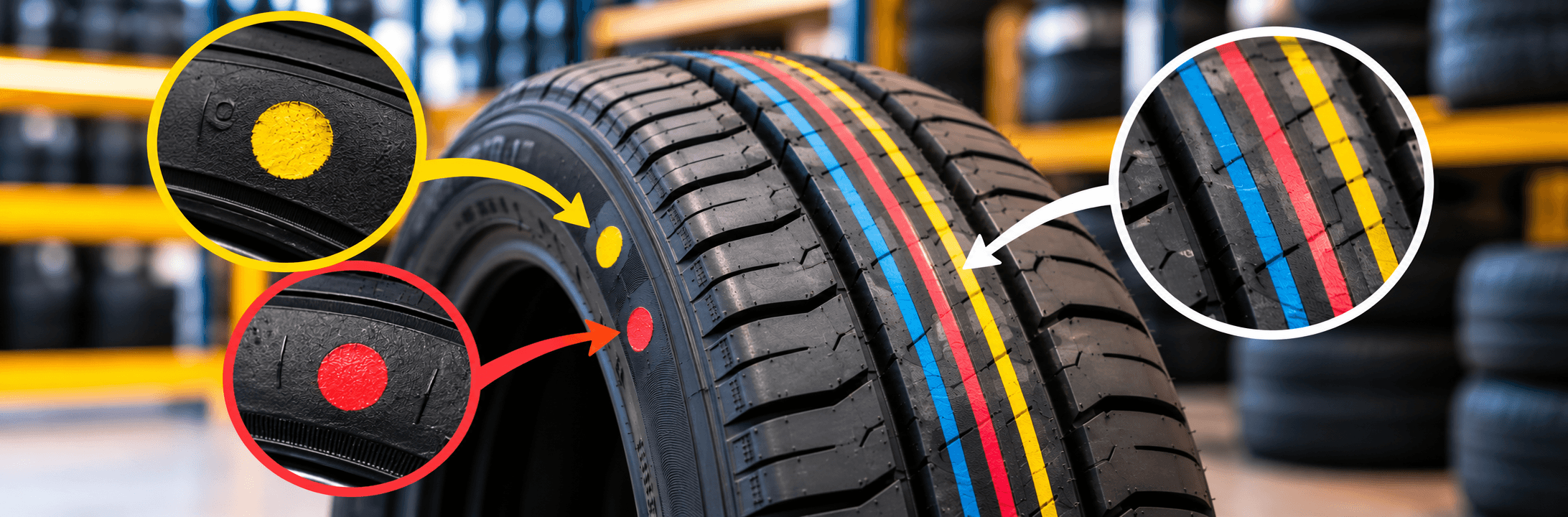
The yellow dots, red dots, and colored stripes on new tyres usually aren't indicators of damage or low quality; they're manufacturing or fitting reference marks. Technicians use yellow and red dots to ensure a tyre fits properly on a wheel for balancing, and manufacturers use coloured tread stripes during production and handling.
However, marking systems differ among tyre manufacturers, so their meaning depends on the tyre. Knowing these markings can help you buy new car tyres online or inspect a new set of tyres that has been installed. They are not a substitute for checking the correct tyre size, manufacturing date, condition, and compatibility with the vehicle.
What Does a Yellow Dot on a New Tyre Mean?
On some tyres, a yellow dot marks the lightest point of the tyre. During installation, the fitter may align it with the wheel’s valve stem, which can be a relatively heavy point on the wheel.
This matching process may reduce the amount of balancing weight required. However, marking systems and mounting instructions vary by manufacturer, so the fitter should follow the relevant guidance.
However, this isn't a universal rule for all tyres. Other manufacturers use different markings or mounting processes, and the valve stem point isn't always the heaviest point on the wheel in every design. The technician should follow the tyre and wheel manufacturer's instructions.
A yellow dot doesn't mean the tyre is faulty, worn, or low quality. It guides proper mounting.
What Does a Red Dot on a New Tyre Mean?
On some tyres, a red dot identifies a reference point related to tyre uniformity, such as radial force variation. If the wheel has a corresponding reference mark, the fitter may align the two points to improve the tyre-and-wheel assembly. The meaning of the red mark depends on the tyre and wheel manufacturer.
This is also called match mounting. It may help eliminate some variations before final balancing, but the process varies with tyre and wheel design.
A red dot can have different meanings depending on the manufacturer and use. Markings can differ even between tyre categories. For example, Continental’s guidance for certain motorcycle tyres tyres assigns a specific meaning to the red dot and explains how it should be aligned during mounting. Do not assume the same rule applies to every passenger-car tyre.
A red dot does not automatically indicate a defect or superior quality. It is a fitting reference, and the technician should follow the manufacturer's instructions to interpret it correctly.
What Do Coloured Stripes on New Tyre Treads Mean?
Coloured stripes running along the tread of a new tyre are generally factory identification marks. Coloured stripes on the tread are generally factory identification marks used during tyre production and handling. Their specific meaning can vary by manufacturer, and they are not a universal code that consumers can use to identify a tyre’s size, age or performance.
These are not a universal consumer code. No single meaning applies to a blue stripe, a red stripe, or a combination of colours across all tyre brands. The stripes can fade with tyre use and tread wear. Losing them is normal and doesn't mean the tyre has lost a safety feature.
Never rely on tread stripes to determine tyre age, performance or authenticity. Rather, verify the manufacturer's marks, product specifications, manufacturing-date code and warranty paperwork.
Do These Marks Affect Tyre Balancing?
They may help the technician assemble the tyre-and-wheel assembly, but they don't negate balancing. Wheel balancing corrects uneven weight distribution in the assembled tyre and wheel. If the assembly is unbalanced, you might experience steering-wheel or vehicle vibration at certain speeds.
During mounting, a technician can use the tyre's reference marks and read the balance on a balancing machine. To correct the wheel, add small weights as needed. If vibration persists after replacing the tyres, ask the workshop to check the balance, tyre seating, wheel condition, and tyre uniformity. Do not assume the coloured marks alone are responsible.
Do You Need to Worry If New Tyres Have No Coloured Dots?
No. Not all tyres display coloured dots or stripes. Marks vary by manufacturer, design, and manufacturing process, and their absence does not indicate a faulty or unsuitable tyre.
When buying tyres, pay attention to the specifications that establish compatibility and safety:
- Tyre size: Match the size approved by the vehicle manufacturer.
- Load index and speed rating: Ensure both meet the vehicle’s requirements.
- Manufacturing date: Check the date code and consider the tyre’s storage history and condition.
- Physical condition: Look for cuts, bulges, cracks and other visible damage.
- Correct fitment: Follow any directional arrows and “Inside” or “Outside” sidewall markings.
Michelin recommends checking tyre pressure at least once a month and before long journeys, with the tyres cold. Use the pressure specified by the vehicle manufacturer rather than the maximum printed on the tyre sidewall.
What Should You Check When Buying New Tyres Online in the UAE?
When comparing tyres by brand, don't judge a product by its coloured stripes or dots. Start by confirming the tyre size, load index, speed rating, and any vehicle-specific requirements. In case of doubt, refer to the tyre information placard or the owner manual.
Compare the date of manufacture, warranty conditions, fitting cost, and balancing costs, then select a tyre shop. The fitter should clarify any markings if the mounting directions are unclear.
If a new tyre vibrates, goes flat, or shows visible damage, check it rather than assuming the coloured marks indicate a problem. A proper inspection can determine whether the problem is with mounting, balancing, the wheel, or the tyre itself.
Conclusion
Yellow dots, red dots and coloured tread stripes on new tyres are generally manufacturing or fitting references, not signs of poor quality. Their meanings vary by manufacturer, so rely on the correct tyre specifications, manufacturing-date code and professional fitting rather than interpreting the markings alone.
If you’re looking to buy new tyres online in the UAE, visit TyresCart to compare available brands, sizes and prices. Check the full fitted cost, warranty terms and available delivery or installation options before ordering.
Browse TyresCart’s tyre selection, choose the correct specifications for your vehicle, and check out the available fitting options to arrange your tyre purchase.