
Motorcycle tyres are engineered to deliver predictable grip, braking stability, and directional control across a range of riding conditions. Their performance depends not only on rubber quality but also on tyre tread pattern, tyre profile geometry, and internal radial construction or bias-ply construction . When tyre wear develops evenly, performance degrades gradually and predictably. However, uneven wear patterns can significantly affect handling precision, cornering stability, and braking efficiency long before the tread reaches its legal wear limit. Identifying and correcting the causes of uneven wear is essential for maintaining safety, extending tyre life, and protecting suspension and drivetrain components.
Uneven Motorcycles tyre wear rarely occurs without a mechanical or operational reason. Factors such as incorrect tyre pressure, misalignment, suspension imbalance, aggressive riding habits, improper load distribution, and road surface conditions all influence tread wear patterns. Additionally, elements such as motorcycle chassis geometry, swingarm pivot alignment, and steering head bearings condition can subtly alter how load transfers through the tyres.
This guide explains the most common uneven wear patterns, their underlying causes, and the practical fixes that restore balanced performance.
Understanding Normal vs. Uneven Motorcycle Tyre Wear
Motorcycle tyres naturally wear down as rubber compounds interact with the road surface. The surface abrasion rate depends on compound composition, riding speed, and environmental temperature. Under normal conditions, the tread should reduce uniformly across the contact patch, maintaining consistent contact patch pressure distribution.
On sport and commuter motorcycles, the rear tyre typically wears faster than the front due to acceleration forces and sustained throttle modulation. On touring Motorcycles, extended highway riding may cause slightly more wear in the center of the rear tyre due to prolonged upright positioning and reduced lean transitions. These patterns are predictable and symmetrical.
Uneven wear differs because it develops inconsistently across the tread surface. It may appear as cupping, scalloping, flat spots, one-sided shoulder wear, diagonal patterns, or localized bald patches. In some cases, irregular wear may compromise the internal tyre carcass, affecting structural support. Such patterns often indicate a mechanical imbalance or incorrect operating conditions rather than simple mileage-based wear.
Left unresolved, uneven wear reduces traction consistency, increases vibration, and can compromise braking and cornering control. It may also influence tyre deformation under load, altering steering feedback.
Regular inspection allows riders to differentiate between natural tread reduction and abnormal wear progression. Monitoring tread depth alongside load index and speed rating compliance ensures tyres are operating within intended parameters.
Common Types of Uneven Wear in Motorcycle Tyres
Cupping or Scalloping
Cupping, also known as scalloping, appears as alternating high and low spots around the tyre circumference. This pattern is more common on front tyres and often creates a rhythmic vibration during riding. The tread blocks may feel wavy or uneven when running a hand across the surface.
This wear pattern typically results from suspension issues, particularly worn or improperly damped front forks. Inadequate control of oscillation frequency within the suspension allows the tyre to momentarily lose consistent contact with the road. When damping is insufficient, the tyre reconnects under load, creating irregular wear patches.
Incorrect tyre pressure, compromised wheel bearings, or excessive unsprung weight can also contribute to cupping. Over time, the pattern worsens and affects steering stability and braking predictability.
Center Wear (Flat Spotting)
Excessive wear in the center of the tyre tread is common among riders who frequently travel long distances on highways. A flattened profile develops as the tyre experiences prolonged upright riding with minimal lean angle. This flattening alters the original tyre profile geometry, making transitions into corners less fluid.
Overinflation accelerates center wear by concentrating the contact patch toward the middle of the tread. It reduces necessary sidewall flex, increasing stress in a confined area. Heavy loads or aggressive acceleration can also increase stress in this region.
Repeated tyre heat cycles without adequate cooling intervals may further harden the compound, increasing center degradation. Once a significant flat spot forms, steering responsiveness becomes less progressive and may feel abrupt during lean initiation.
Edge or Shoulder Wear
Shoulder wear occurs when the outer edges of the tyre degrade faster than the center. This pattern is common among sport riders who frequently corner at higher lean angles. Underinflation increases sidewall flex, expanding the contact patch and shifting pressure toward the shoulders.
Incorrect shock absorber sag settings or improper rebound control can amplify braking load transfer, increasing outer edge stress during corner entry. Aggressive riding combined with softer tyre compounds also accelerates shoulder wear.
One-Sided Wear
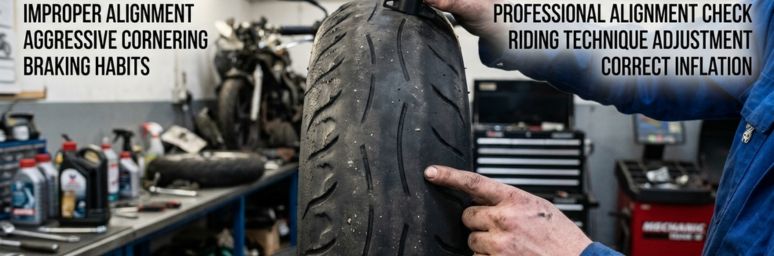
When one side of the tyre wears significantly faster than the other, mechanical alignment becomes a primary concern. Rear wheel misalignment places uneven stress across the tread, especially during acceleration.
Consistent riding on cambered roads can gradually encourage uneven shoulder degradation. Additionally, issues such as improper wheel runout tolerance or worn steering head bearings can influence load bias and lead to uneven wear.
Diagonal or Patch Wear
Diagonal wear patterns may appear as angled streaks or irregular patches across the tread surface. These often result from aggressive braking, abrupt throttle inputs, or inconsistent suspension damping.
Patch wear can also occur if a tyre has experienced localized overheating, uneven pressure distribution, or compound fatigue from repeated heat cycles.
Primary Causes of Uneven Motorcycle Tyre Wear
Incorrect Tyre Pressure
Tyre pressure directly affects the size and shape of the contact patch. Overinflation reduces the contact area, increasing stress in the center of the tread, while underinflation increases heat and alters deformation characteristics.
Maintaining manufacturer-recommended tyre pressure ensures balanced load distribution and optimal grip. Riders should measure pressure when tyres are cold and adjust based on load and riding conditions.
Suspension Imbalance or Wear
Motorcycle suspension components regulate how forces transfer between the tyre and chassis. Worn fork seals, degraded damping oil, or incorrect preload settings alter braking load transfer dynamics.
Improper suspension setup creates inconsistent geometry, increasing oscillation and uneven road contact. Proper tuning ensures consistent tyre loading and stable handling.
Wheel Misalignment
Rear wheel alignment errors are a common cause of uneven tyre wear. Even minor deviations introduce lateral stress and increase rolling resistance.
Correct alignment ensures the wheels track precisely within the motorcycle’s intended geometry, improving tyre longevity and handling stability.
Wheel Imbalance
An imbalanced wheel rotates unevenly, placing inconsistent pressure across tread sections. This may result from improper balancing or uneven tyre mounting.
Dynamic balancing minimizes rotational inconsistencies and reduces strain on wheel components.
Riding Style and Braking Habits
Aggressive acceleration, frequent hard braking, and abrupt throttle inputs significantly influence wear patterns. Controlled riding distributes mechanical stress more evenly and reduces localized wear.
Road Surface and Environmental Factors
Rough asphalt, debris, and high temperatures increase tyre wear. Hot surfaces intensify heat cycles, affecting compound durability.
Selecting tyres suited to riding conditions helps maintain even wear and consistent performance.
Effects of Uneven Tyre Wear on Motorcycle Performance
Uneven tyre wear alters the tyre profile and disrupts predictable handling. Flat spots make steering transitions abrupt, while cupping introduces vibration and noise.
Reduced tread consistency compromises braking efficiency and traction, especially in wet conditions. If wear reaches the internal structure, tyre integrity declines, increasing failure risk.
Practical Fixes for Uneven Motorcycle Tyre Wear
Maintain correct tyre pressure, ensure proper suspension setup, verify accurate wheel alignment, and perform balancing during installation.
Inspect wheel bearings, monitor suspension settings, and replace tyres when wear indicators are reached or when profile distortion affects stability.
Preventive Maintenance Strategy
A structured maintenance routine minimizes uneven tyre wear. Riders should regularly inspect tread depth, sidewalls, alignment, and vibration behavior.
Monitoring suspension and load distribution ensures balanced wear progression. Preventive maintenance extends tyre life while maintaining consistent handling performance.
motorcycle-tyre are a critical safety component. Proper care, setup, and riding habits ensure even wear, reliable grip, and long-term performance.